
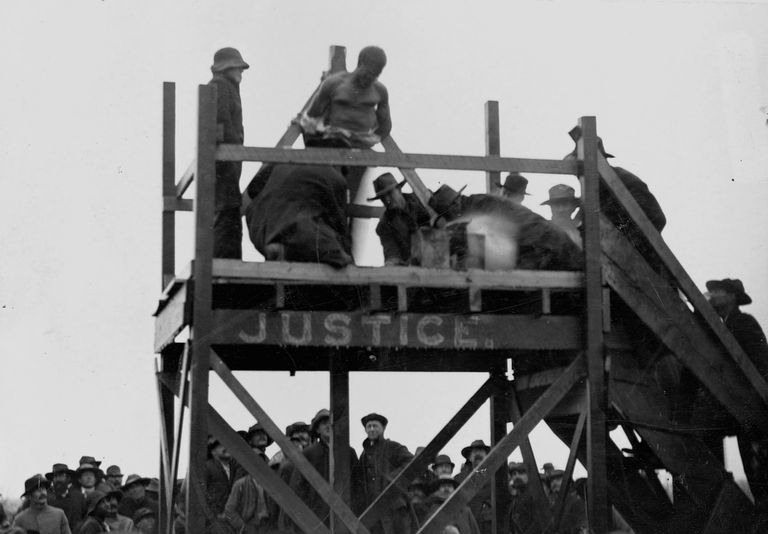
The lynching of Henry Smith remains one of the most horrifying examples of racial terror in late nineteenth-century America. His killing, carried out on February 1, 1893, in Paris, was not a secret act of mob violence committed under cover of darkness. It was a public spectacle, announced in advance, attended by thousands, and treated by many white residents as a community event. The brutality of the lynching shocked observers around the world and exposed the depth of racial hatred embedded in American society during that era.
Henry Smith was a young Black laborer who had been working in Paris, Texas. In January 1893, three year old Myrtle Vance, the daughter of a local police officer, went missing and was later found dead. The discovery devastated the town and ignited immediate outrage. Suspicion quickly focused on Smith, reportedly because he had once worked for the child’s father and may have had a prior dispute. Fear and anger spread rapidly, and before any formal legal proceedings could begin, rumors hardened into certainty in the minds of many white citizens.
Fearing violence, Smith fled the area. However, he was soon located in Arkansas by a posse and arrested. Instead of being protected by law enforcement and guaranteed a fair trial, he was transported back to Texas to face a mob that had already decided his fate. Newspapers of the time openly reported that a lynching was expected. Crowds prepared in advance. Special trains were arranged to bring spectators from neighboring towns, and local businesses reportedly closed so employees could attend.
On the day of the lynching, an estimated several thousand people gathered in an open field in Paris. A wooden platform had been constructed, turning the execution into a staged public event. Smith was brought before the crowd, reportedly forced to confess, though the circumstances under which any confession was made were coercive and unreliable. He was tied to a scaffold, and what followed was a prolonged act of torture.
According to contemporary accounts, members of the victim’s family were permitted to participate in the punishment. Smith was tortured with heated irons for an extended period while the crowd watched. The cruelty was deliberate and slow. Eventually, he was doused with flammable liquid and set on fire. Witnesses described cheering and shouting as he died. Some members of the crowd reportedly collected charred wood from the platform as souvenirs, a chilling reflection of how normalized such violence had become.
The lynching of Henry Smith was extraordinary not only for its brutality but also for the publicity it received. Newspapers across the United States reported on the event in detail, and international coverage followed. Photographs and written accounts circulated widely. While some newspapers sensationalized the story, others expressed horror at the barbarity of the act. The event forced many outside the South to confront the reality of racial violence that Black Americans faced daily.
At the time, lynching was a common tool of racial control in the United States, particularly in the South. Black men were frequently accused of crimes, especially against white women or children, and were denied the presumption of innocence. Accusations alone often triggered mob violence. Legal systems routinely failed to intervene, and white participants in lynchings were almost never prosecuted.
The case became part of the growing anti-lynching campaign led by journalist and activist Ida B. Wells. Wells documented lynchings across the country and challenged the narrative that they were acts of justice. She argued that many accusations were exaggerated or false and that lynching functioned as a method of terror designed to maintain white supremacy after the end of Reconstruction. The killing of Henry Smith became one of the examples cited in discussions about the savagery and lawlessness of mob rule.
No one was ever held accountable for Smith’s torture and death. The lack of prosecution reflected a broader pattern in which local authorities either participated in or deliberately ignored lynchings. The message to Black communities was clear: the legal system would not protect them. This climate of fear shaped African American life for generations, contributing to migrations, economic hardship, and deep mistrust of institutions.
Today, historians examine the lynching of Henry Smith as a stark illustration of racial terror in the post Reconstruction era. It demonstrates how mob violence was not simply spontaneous outrage but often organized, public, and socially sanctioned. The participation of families, the attendance of large crowds, and the involvement of local infrastructure reveal a community complicit in racial brutality.
Remembering Henry Smith is part of acknowledging the broader history of lynching in America. Thousands of African Americans were killed in similar acts of violence between the late nineteenth and early twentieth centuries. Their deaths were intended not only to punish individuals but also to send a message of intimidation to entire communities.
The story of Henry Smith forces a reckoning with the realities of racial hatred and the consequences of abandoning the rule of law. It stands as a somber reminder of how easily justice can be replaced by vengeance when prejudice and fear are allowed to dominate. By confronting this history honestly, society honors the memory of those who suffered and strengthens the commitment to equality, due process, and human dignity.