
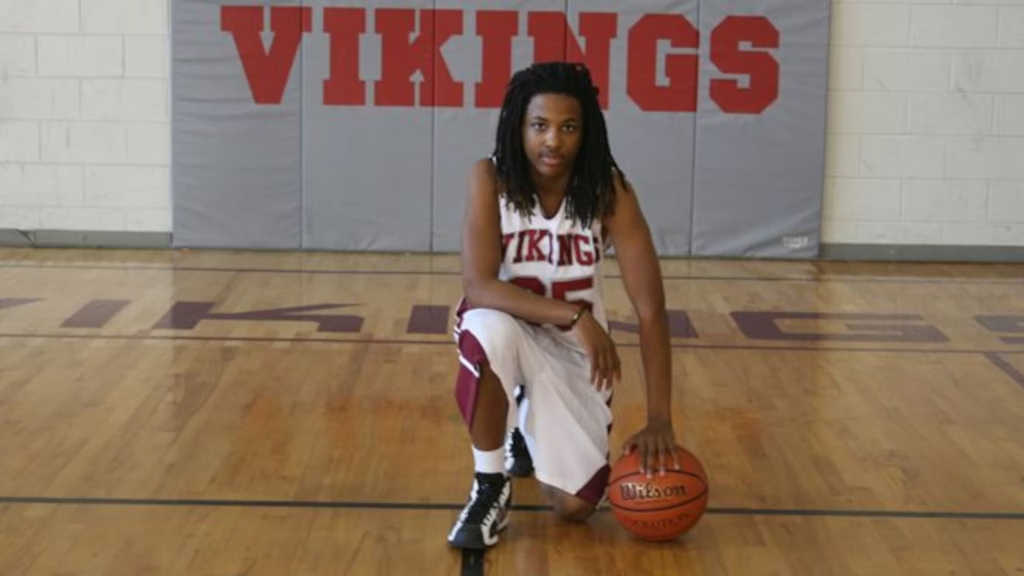
Kendrick Johnson was seventeen years old when he died inside his high school gymnasium in Valdosta, Georgia, his body discovered on January 11, 2013, rolled up inside a vertical wrestling mat with his feet sticking out from the top. He was a three-sport athlete at Lowndes High School, well-liked and known to his friends as KJ, with no apparent troubles that would foreshadow the mysterious circumstances of his death. The last time anyone saw him alive was the previous afternoon around one twenty-seven, captured on school surveillance video near the gym mat area, and by the next morning he was dead.
The initial investigation by the Lowndes County Sheriff’s Office concluded quickly that Kendrick’s death was a tragic accident. According to their theory, he had been reaching for a shoe that he and another student shared, a pair of Adidas that they would toss inside the hollow center of the rolled mats for storage. In this version, Kendrick dove headfirst into the mat, became stuck, and died of positional asphyxia, unable to breathe in the tight space. The Georgia Bureau of Investigation autopsy supported this finding, and the case was closed within months, ruled accidental.
But Kendrick’s parents, Kenneth and Jacquelyn Johnson, never accepted this explanation. From the beginning, they pointed to bruising on their son’s right jaw and marks on his wrist that they believed were consistent with stun gun prongs. They noted that Kendrick was found with his shoes in his hand, not on his feet, contradicting the theory that he was reaching for a missing shoe. They questioned why a student would dive headfirst into a narrow mat opening barely fifteen inches wide, and why no one heard him call for help if he had been trapped and struggling to breathe.
The family secured a court order to exhume Kendrick’s body for a second autopsy, and what the private pathologist discovered only deepened their suspicions and horror. Dr. William Anderson found that Kendrick’s death was caused by blunt force trauma to the right side of his neck, not positional asphyxia, and concluded that the manner of death was not accidental. Even more disturbing was the condition of the body itself. When Dr. Anderson opened the remains, he found that every organ from the pelvis to the skull was missing. The brain, heart, lungs, liver, and other viscera had been removed and never returned. In their place, the body cavity had been stuffed with old newspapers and department store circulars, filled like a garbage can according to Jacquelyn Johnson. The funeral home claimed they never received the organs from the GBI, which stated they had placed them back in the body before releasing it. The Georgia Secretary of State investigated and found the funeral home’s practices were not best standards, though they cleared them of wrongdoing.
The case began to attract national attention as these macabre details emerged. Civil rights attorney Benjamin Crump, who had represented Trayvon Martin’s family, joined the Johnsons’ cause. The U.S. Attorney for the Middle District of Georgia announced a federal review in October 2013, and the Department of Justice opened a formal civil rights investigation. Federal agents interviewed nearly a hundred people, reviewed tens of thousands of emails and texts, and examined surveillance footage from the school. They looked into allegations that two sons of an FBI agent, Brian and Brandon Bell, were involved in Kendrick’s death, a theory the Johnsons pursued in civil litigation. The family filed a one hundred million dollar lawsuit alleging a conspiracy to cover up murder, naming thirty-eight defendants including classmates, school officials, and law enforcement officers. The lawsuit was eventually withdrawn, and a judge ordered the Johnsons and their attorney to pay nearly three hundred thousand dollars in legal fees to the defendants, finding they had fabricated evidence.
In June 2016, the Department of Justice announced it would file no criminal charges, stating there was insufficient evidence to support federal criminal charges. The investigation was closed, leaving the family devastated and the case officially unresolved in their eyes. But the story did not end there. In 2021, Lowndes County Sheriff Ashley Paulk, who had been retired at the time of Kendrick’s death, reopened the investigation after finally obtaining federal case files he had requested for years. He spent months reviewing approximately seventeen boxes of documents from the FBI, Department of Justice, and local agencies. In January 2022, he released a sixteen-page synopsis attempting to address all the rumors that had swirled for nearly a decade. Paulk stated he was one hundred percent sure there was no foul play, calling it a terrible accident. He noted that seven different people testified that students regularly stored shoes in the mats and crawled inside to retrieve them, and he questioned the timing and relationships involved in the amended federal autopsy reports.
The Johnson family responded with continued disbelief. Jackie Johnson went on Facebook Live within hours of the synopsis release, calling the report lies and stating they were not dismayed because they had expected exactly what Paulk said. They continued to point to the surveillance video that captured Kendrick’s final walk, footage that a former FBI agent called highly suspicious, and to the independent autopsy findings of blunt force trauma. The family filed another lawsuit in 2023, this one for one billion dollars against the sheriff’s office, crime lab, GBI, school board, and an unnamed FBI agent, continuing their legal battle more than ten years after Kendrick’s death.
The case has become a focal point for debates about justice, accountability, and the treatment of Black families by law enforcement and institutions. A documentary film titled Finding Kendrick Johnson was released in 2021, examining the evidence and the family’s quest for answers. Hundreds of people from organizations like Israel United in Christ have marched in Atlanta demanding justice. In February 2025, a federal appeals court asked a Georgia court to reconsider the dismissal of the family’s lawsuit, keeping the legal proceedings active even as the central question remains unanswered.
The stark contrast between the official finding of accidental death and the family’s belief in murder, the disturbing handling of Kendrick’s body, the missing organs replaced with newspaper, and the conflicting autopsy results have created a case that refuses to be closed. For the Johnsons, the fight continues not just for a different ruling on a death certificate, but for acknowledgment that their son’s life mattered and that the truth, whatever it may be, deserves to be fully revealed.