
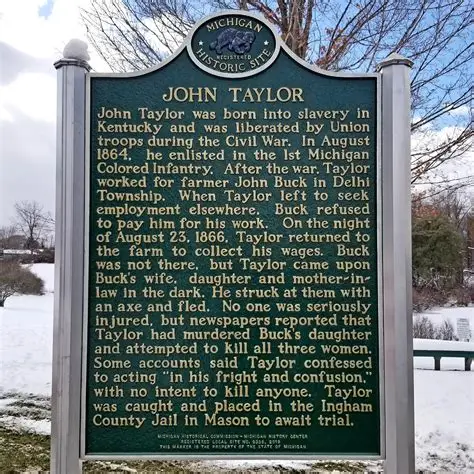
John Taylor was a 17-year-old African American boy whose life was brutally cut short by a lynching, an act that tragically reflects the racial hatred and injustice that pervaded the United States even in Northern states during the Reconstruction era. Born into slavery in Kentucky, Taylor had endured the hardships of servitude during his early years. When the Civil War broke out, he sought the chance for freedom and justice, eventually joining the U.S. Colored Infantry, serving his country despite the discrimination and danger he faced as a Black soldier. After the war ended, Taylor, like many formerly enslaved people, tried to build a new life. He traveled north to Michigan, hoping to find work and a community where he could live safely in freedom.
In Michigan, John Taylor found employment as a farm laborer. By all accounts, he was a hard-working young man, trying to live an honest life. However, racial prejudice and fear of Black advancement still ran deep in many communities. In 1866, a disagreement related to his employment, coupled with local rumors, sparked a chain of events that would end in tragedy. Word spread quickly through Mason, Michigan, exaggerating and distorting the situation. Some claimed that Taylor had committed a violent crime, though no evidence supported this, and no trial had taken place. The atmosphere in the town became charged, with neighbors and strangers alike filled with anger and suspicion.
Despite being in the protection of the law and awaiting trial in the Ingham County jail, Taylor was not safe. A mob formed, determined to take “justice” into their own hands. Before any legal process could establish the truth, the mob stormed the jail, seized the teenager, and dragged him to a nearby tree near the Mason railroad depot. There, without a trial or any chance to defend himself, John Taylor was hanged. His youth made the crime even more horrifying; he was only seventeen years old, a boy who had survived slavery and war, now killed by the very society he had sought to live in peacefully.
The aftermath of Taylor’s lynching highlighted the failures of the justice system at that time. Although some community members were shocked and newspapers condemned the act, others sought to justify it. A grand jury convened and brought indictments against several men involved in the lynching, yet none were convicted, and most charges were eventually dropped. The legal system failed to protect him, and no one was held accountable for the murder of a defenseless teenager.
John Taylor’s burial site was not preserved, and for many years, his story was largely forgotten. However, historians and community members have worked in recent decades to remember his life and death. Efforts include renaming local landmarks in his honor and highlighting his story as part of the broader history of racial violence in America. By remembering John Taylor, communities acknowledge the injustices of the past and recognize the vulnerability of Black Americans in the post-Civil War era.
Taylor’s lynching is a stark reminder that racial terror did not end with slavery and that the promise of freedom was often met with violence and fear. It also reflects the broader struggle for civil rights, justice, and recognition of human dignity that would continue for generations. Though he was only seventeen, John Taylor’s life and tragic death remain a powerful testament to the resilience of those who endured oppression and the necessity of remembering these painful chapters of history to ensure they are never repeated