
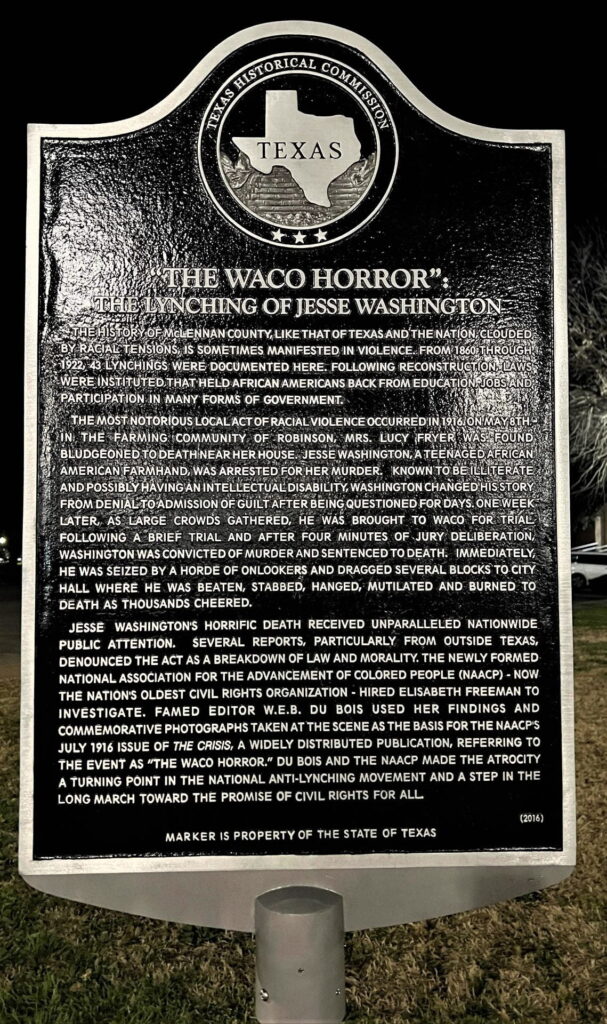
Jesse Washington was a 17-year-old African American farmhand whose life was taken in one of the most horrific acts of racial violence in American history. His lynching on May 15, 1916, in Waco, Texas, became a symbol of the brutality of mob justice and the deep racial hatred that defined much of the Jim Crow era.
Washington was born around 1898 and worked on farms in the rural areas surrounding Waco. Like many young Black men of his time, he lived in poverty and had limited access to education. In May 1916, he was accused of murdering Lucy Fryer, the wife of a white farmer for whom he had been working. Washington was quickly arrested and brought to Waco to stand trial. The atmosphere in the town was already tense, and rumors and anger spread rapidly among white residents even before the trial began.
The legal process moved with alarming speed. On the morning of May 15, Washington was brought before a courtroom packed with spectators. The trial lasted only a few hours. He reportedly confessed during the proceedings, though there were serious questions about whether the confession was coerced. He had no meaningful legal defense, no time to prepare, and little protection from the court. After a brief deliberation, the all-white jury returned a guilty verdict and sentenced him to death.
What happened next exposed the complete breakdown of law and order. Before the judge could formally carry out the sentence, a large mob stormed the courtroom. They seized Washington, beat him, and dragged him outside. Local authorities made little effort to intervene. The mob chained him by the neck and transported him to the town square, where thousands of people gathered, including men, women, and children.
In the center of Waco, the mob built a fire and suspended Washington over the flames. He was lowered and raised repeatedly, tortured for an extended period while the crowd watched. Members of the mob mutilated his body, and many spectators treated the event as a public spectacle. Photographs were taken, and pieces of his remains were collected as souvenirs. After he died, his body was burned further, and the charred remains were hung for public viewing.
The lynching lasted for hours and occurred in broad daylight, with virtually no attempt by law enforcement or city officials to stop it. The scale and public nature of the violence shocked even some observers at the time. The event became known as the “Waco Horror.”
News of the lynching spread across the country, largely because of the work of the National Association for the Advancement of Colored People (NAACP). Civil rights activist Elizabeth Freeman traveled to Waco to investigate the killing. The NAACP published a detailed report along with photographs in its magazine, The Crisis, edited by W.E.B. Du Bois. The images and eyewitness accounts exposed the brutality of lynching to a national and international audience and helped galvanize early anti-lynching activism.
Despite the overwhelming evidence and the public nature of the crime, no one was ever charged or held accountable for Washington’s murder. The failure to prosecute reflected the broader system of racial injustice in the South, where lynching was often tolerated or ignored by authorities.
The lynching of Jesse Washington became a turning point for the anti-lynching movement. It strengthened the NAACP’s campaign for federal anti-lynching legislation and helped bring greater awareness to the epidemic of racial violence facing African Americans. Although federal anti-lynching laws would not be passed for many decades, the outrage generated by the Waco lynching helped build the foundation for later civil rights efforts.
Today, Jesse Washington’s death is remembered as a stark reminder of the dangers of mob violence, racial hatred, and the failure of the justice system to protect Black lives. His story continues to be studied and memorialized as part of the broader effort to confront the history of racial terror in the United States. Remembering what happened in Waco in 1916 is not only about honoring the memory of a young life lost but also about acknowledging the painful past and the long struggle for justice and equality that followed.