
Sam Carter was one of the first victims of racial violence during the Rosewood Massacre, one of the most tragic and destructive racial attacks in American history. His lynching on January 1, 1923, in Rosewood, Florida, became a turning point that helped ignite days of terror against the Black community.
Sam Carter was an African American man and a respected resident of Rosewood, a small, predominantly Black town in Levy County, Florida. Like many Black men of the time, he worked hard to support himself and was known in the community as dependable and trustworthy. Rosewood itself was a self-sufficient Black town with homes, churches, a school, and businesses. Despite its progress, it existed in a region marked by deep racial tension during the Jim Crow era.
The events leading to Carter’s death began on January 1, 1923, when a white woman in the nearby town of Sumner claimed she had been assaulted by a Black man. Although there was little evidence and conflicting accounts about what actually happened, rumors quickly spread through the white community. These rumors fueled anger and fear, and armed white posses formed almost immediately, determined to find a Black suspect.
During the search, white vigilantes focused on Sam Carter. They believed he had helped an escaped Black prisoner who they suspected might be connected to the alleged assault. Carter was seized by a mob and forced at gunpoint to accompany them into the woods to show where he had last seen the man. When tracking dogs failed to locate anyone, the mob’s anger turned on Carter himself.
What followed was brutal. Carter was tortured and beaten by the mob. Witness accounts and later historical research indicate that he was shot multiple times before his body was hung from a tree. His mutilated body was left on display as a warning and symbol meant to terrorize the Black population in the area. Some members of the mob reportedly took pieces of his clothing as souvenirs.
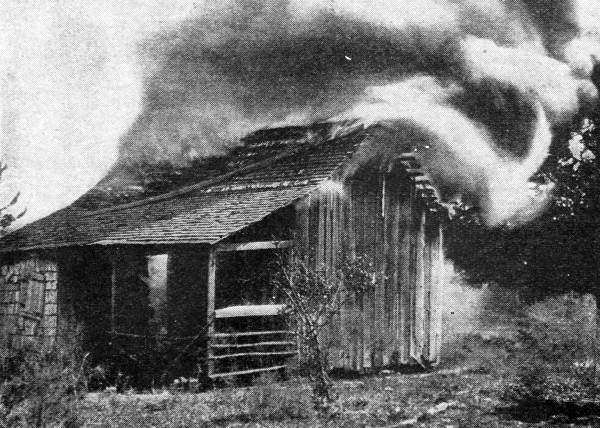
The lynching of Sam Carter did not end the violence. Instead, it helped ignite a wave of attacks that escalated into the Rosewood Massacre. Over the next several days, armed white mobs invaded Rosewood, burning homes, churches, and businesses. Black families fled into nearby swamps to hide for their lives. An unknown number of people were killed, with estimates ranging from dozens to possibly more than a hundred. Many survivors never returned, and the town of Rosewood was effectively wiped off the map.
No one was ever held accountable for Carter’s lynching or the destruction of the community. Local authorities did little to stop the violence, and grand juries later failed to indict any members of the mobs. Like many acts of racial terror during the era, the crime went unpunished.
For decades, the story of Sam Carter and Rosewood remained largely hidden. Survivors rarely spoke publicly out of fear or trauma. It was not until the late 20th century that the massacre gained national attention. In 1994, Florida became the first state to provide compensation to survivors and their descendants, officially acknowledging the injustice.
Sam Carter’s death represents more than a single act of mob violence. It reflects the climate of racial terror that existed in the early 20th century, where accusations alone could lead to torture and death, and entire communities could be destroyed without consequence. His lynching stands as a painful reminder of how fear, racism, and mob rule were used to control and intimidate Black Americans during the Jim Crow era.