
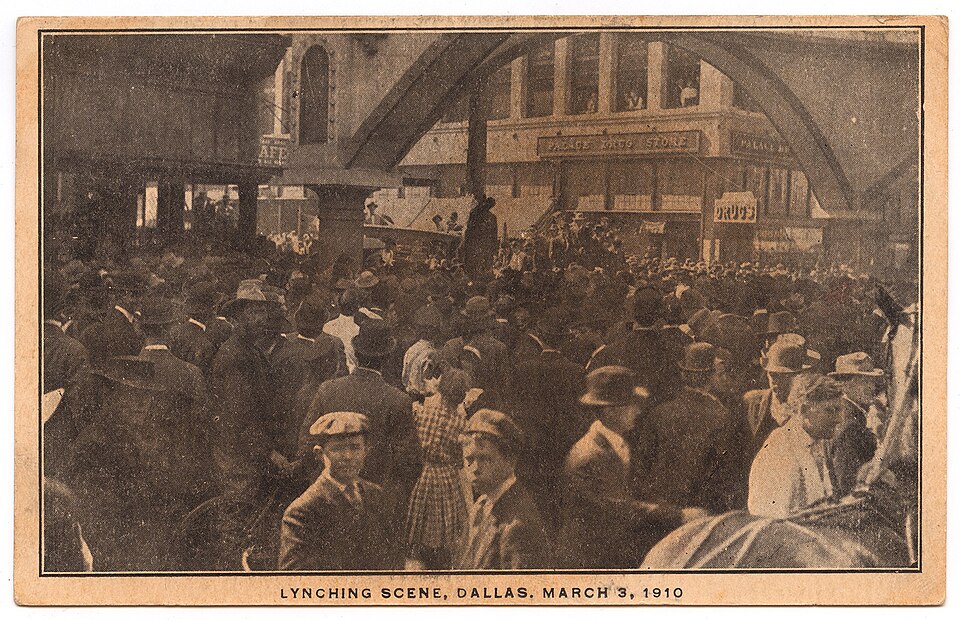
The lynching of Allen Brooks remains one of the most brutal and openly displayed acts of racial terror in American history. It occurred on March 3, 1910, in Dallas, during an era when justice for Black Americans was often overshadowed by mob violence and deep-rooted racism. What makes this case especially disturbing is not only the cruelty of the act itself, but the fact that it unfolded in broad daylight, in front of a massive crowd, with little to no attempt by authorities to stop it.
Allen Brooks was an elderly Black laborer who had been working as a handyman. He was accused of assaulting a young white girl, a charge that immediately inflamed racial tensions in the city. In the early 1900s, such accusations often led to swift and violent retaliation, regardless of evidence or due process. Brooks was arrested and taken to the courthouse, but the legal system never truly had the opportunity to function. The mere accusation was enough to seal his fate in the eyes of many.
As news of the accusation spread, a large white mob began to gather outside the courthouse. Reports estimate that thousands of people, including men, women, and even children, filled the streets. The crowd was not hidden or secretive. Instead, it was open, loud, and fueled by a collective sense of rage and entitlement. This was not just a group of individuals acting in isolation, but a reflection of a society that permitted and encouraged such acts of violence.
Inside the courthouse, tension mounted rapidly. Despite the presence of law enforcement, there was little meaningful effort to protect Brooks. The mob eventually forced its way into the building, overwhelming any resistance. Brooks was seized from the courtroom, and what followed was a horrifying display of unchecked brutality. He was beaten mercilessly, dragged through the streets, and subjected to public humiliation.
The mob carried Brooks to a central area in downtown Dallas, where they hanged him from a telephone pole. But even death did not end the violence. His body was mutilated, burned, and desecrated in front of the cheering crowd. Witness accounts describe people climbing over one another to get closer, treating the event as if it were some form of entertainment rather than a human tragedy. Pieces of his remains were reportedly taken as souvenirs, a chilling testament to the dehumanization that defined these acts.
Perhaps one of the most haunting aspects of this lynching is that it was captured in photographs. The images show Brooks’ lifeless body hanging above a large crowd, many of whom appear calm, even proud. These photographs were turned into postcards and circulated widely, allowing the violence to be shared and remembered not with shame, but with a disturbing sense of normalcy. It highlights how deeply embedded racial hatred was in the culture at the time.
The lynching of Allen Brooks was not an isolated incident. It was part of a broader pattern of racial terror that spread across the United States, particularly in the South, during the late 19th and early 20th centuries. Lynchings were often used as tools of intimidation, designed to instill fear in Black communities and reinforce systems of white supremacy. Accusations, especially those involving alleged crimes against white women, were frequently used to justify these acts, regardless of truth or evidence.
What is equally troubling is the lack of accountability. Despite the public nature of the crime and the large number of witnesses, no one was held responsible for Brooks’ death. This failure of justice sent a clear message that Black lives were not protected under the law. It also reinforced a dangerous precedent that mobs could act without consequence.
The legacy of Allen Brooks’ lynching continues to echo through history. It serves as a stark reminder of the consequences of hatred, misinformation, and systemic injustice. While the United States has made progress in addressing racial inequality, events like this remain essential to remember and confront. They are not just stories of the past, but lessons about what can happen when justice is abandoned and humanity is ignored.
Remembering Allen Brooks is not just about acknowledging a tragic death. It is about recognizing the broader history of racial violence and ensuring that such atrocities are never repeated. His story stands as both a warning and a call to continue striving for justice, equality, and truth in a society that once allowed such horrors to unfold in plain sight.